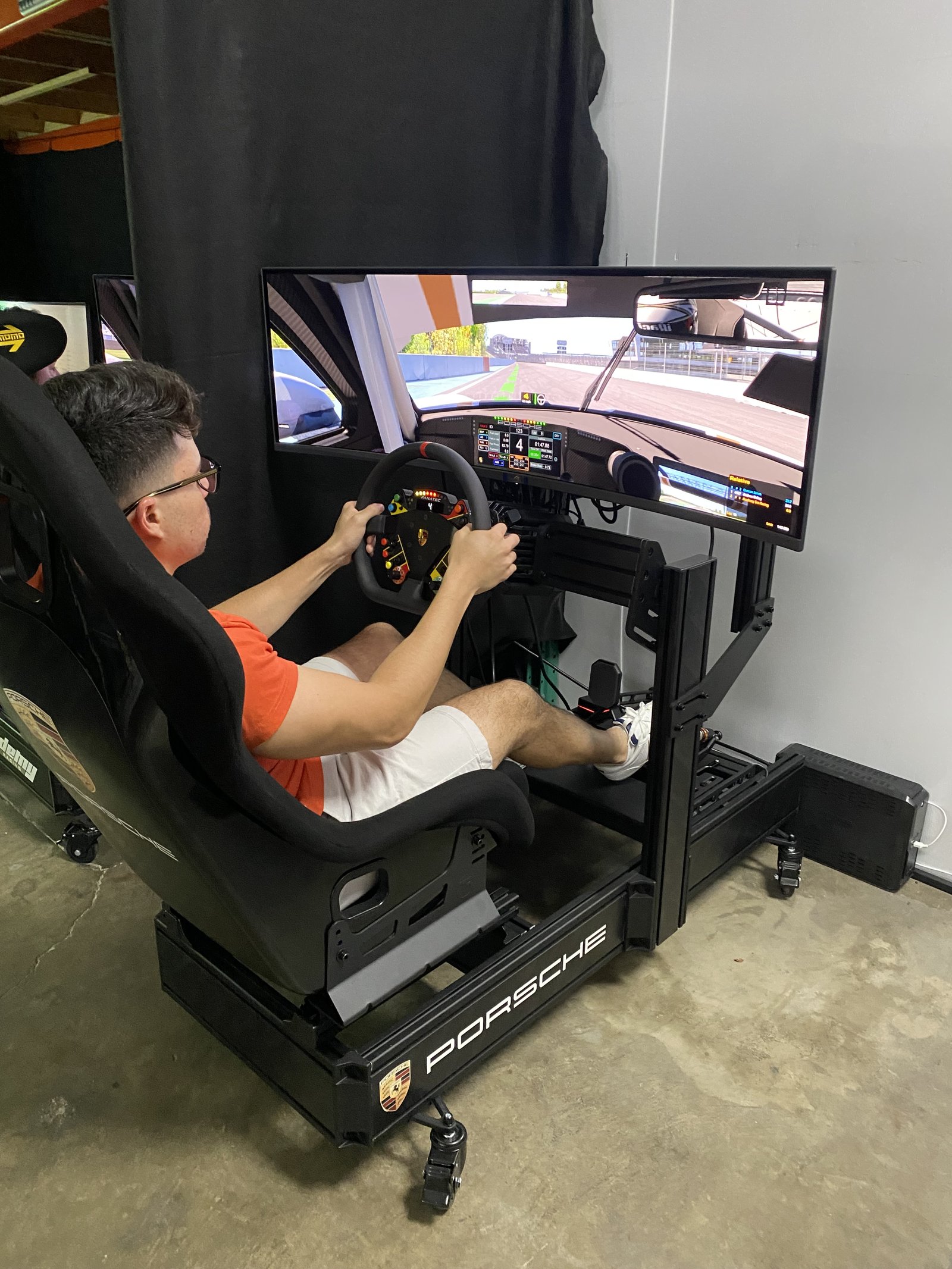
If you already drive on track, a simulator is not a substitute for seat time. It is the thing that stops you spending your first paid session working out which way the circuit goes.
Track time is expensive and there is never enough of it. The part a simulator genuinely takes off your hands is orientation: knowing the sequence of corners, which way they go, what follows what, and which ones matter because they lead onto a straight.
What does not transfer is the feel of your real car, the grip on the day, or your braking references. Those you build on site with an instructor. Anyone selling you more than that is overselling.
Set it up like your actual car rather than like a race car. If you drive a road-based track car, an upright position transfers better than a reclined one.
Fifteen Nm is plenty. You are practicing sequence and consistency rather than chasing the last tenth, and the money is better spent on pedals.
The most important component for this use case. Braking repetition is the thing you cannot practice anywhere else, and a load cell is the minimum for it to mean anything.
Either. A single 49 inch ultrawide is entirely adequate for learning circuits. Triples help if you are moving toward wheel-to-wheel club racing.
iRacing and Assetto Corsa between them cover the circuits you are most likely to be running in Florida and nationally.
A Buttkicker helps you feel curbs and wheelspin, which is useful when learning a circuit. Motion is a genuine benefit but not necessary for this use case.
These are our existing builds, not special editions. The table is the published spec.
| Build | Price | Display | Wheelbase | Pedals | Haptics & Motion |
|---|---|---|---|---|---|
| Rookie | $6,995 | 34" curved WQHD 165Hz | 8Nm direct drive | Load cell | None |
| Base | From $10,000 | 49" curved 144Hz | 15Nm direct drive | Load cell | Buttkicker |
| Club OLED | $16,995 | 49" QD-OLED 240Hz | 25Nm, DD2 or Simucube 3 | Simucube Active | Buttkicker |
For most track day drivers, Base is the sensible build. Rookie is a real entry point if this is your first rig.
This suits you if you run HPDE days, club events or an occasional track weekend and want to arrive already knowing the circuit. It is the most common reason people who already drive on track buy a rig.
Our track guides cover specific Florida circuits in more detail.
A simulator builds familiarity, repetition and consistency. It is practice, not a substitute for real seat time or instruction, and we do not claim it will make you faster on track.
Every build on this site is a rig we run daily in the Tampa lounge.
Tell us the racing you do and the space you have. We will spec it against the real lineup.